
Peter Friedl
11 November 2013 - 15 February 2014
pictures 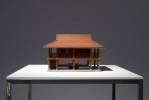

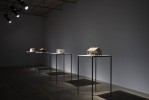
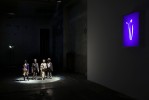


Guido Costa Projects is pleased to present Dénouement, the new solo exhibition of works by Peter Friedl, on the occasion of Artissima’s “Contemporary Arts Night.”
The French word dénouement, which can be translated literally as “untying” has its origins in the theory of drama. It indicates the final resolution of a dramatic plot: tragedy results in a catharsis; comedy is associated with a happy ending. Peter Friedl explores this plurality of meanings masterfully in his output of the last two years, radicalizing his longstanding artistic research on the aesthetic interaction between document and artifact.
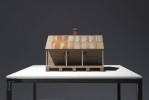
Central to the exhibition is the idea of model and its poetics. Owing to their ability to condense complex realities, Peter Friedl’s oeuvres have always been interpreted as models: as exemplary frameworks and solutions to aesthetic problems involving political and historical consciousness. In the case of Rehousing (2012–13) we are confronted with minutely detailed, scale models of four houses: the artist’s parental home in Austria, representing traces of autobiographical memory and at once an emblem of transience; the private residence of Ho Chi Min in the city of Hanoi, a specific example of political architecture; the modernist utopia of Luigi Piccinato’s Villa Tropicale, a prototype colonial house designed during the Fascist era but never constructed, a draft of which exists in a 1936 edition of the Italian magazine Domus; and finally, a naturalistic model of an anonymous slave hut on the Evergreen Plantation in Louisiana. These are, beyond mimesis, case studies for a mental geography of different forms of modernity.
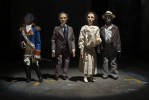
The idea of model is also present in The Dramatist (2013), the second sculptural group in the exhibition: four handcrafted marionettes whose portraits inspire reflection on historiography and political narration. Here, the dramatis personae are: Julia Schucht (1896–1980), the wife of Antonio Gramsci; Toussaint Louverture, the leader of the Haitian Revolution who died a prisoner in France in 1803; John Chavafambira, the “Black Hamlet” from early African psychoanalysis documented in a novelistic narrative in Johannesburg in the 1930s; and the celebrated automobile magnate Henry Ford. Four characters in search of an author to recount their exemplary lives who have already appeared in previous projects and writings by Peter Friedl since the 1990s.
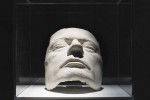
Another piece in the exhibition is a death mask of the artist made while alive—a study in critical intimacy. Framed by the dramaturgy of denouement, it is a laconic model of poetics in which personal stories and fragmented stories of modernity are interwoven.
The exhibition will remain open to the public until Saturday, 15 February 2014.
* * * * *
Peter Friedl (b. 1960) is an artist working in situ. His work has been exhibited internationally in venues such as documenta X (1997), and documenta 12 (2007), the 48th Venice Biennale, 3rd Berlin Biennial for Contemporary Art (2004), Manifesta 7, Trento (2008), the 7th Gwangju Biennale (2008), the 28th Bienal de São Paulo (2008), La Triennale, Paris (2012), and recently the Taipei Biennial (2012) and the 10th São Paulo Architecture Biennale (2013). Solo exhibitions include Luttesdesclasses, Institut d’Art Contemporain, Villeurbanne (2002), OUT OF THE SHADOWS, Witte de With, Center for Contemporary Art, Rotterdam (2004), the retrospective survey Work 1964–2006, Museu d’Art Contemporani de Barcelona, Miami Art Central, Musée d’Art Contemporain, Marseille (2006–07), Blow Job, Extra City Kunsthal Antwerpen, Antwerp (2008), Working, Kunsthalle Basel (2008), and Peter Friedl, Sala Rekalde, Bilbao (2010). Since the 1980s he has published numerous essays and book projects such as Four or Five Roses, Working at Copan, and Playgrounds. A selection of his texts has been released under the title Secret Modernity: Selected Writings and Interviews 1981–2009.
Recent publication: Über Peter Friedl, ed. by Dirk Snauwaert, with essays by Mieke Bal, Roger M. Buergel, Jean-François Chevrier, Norman M. Klein, Bartomeu Mari, Eva Schmidt, Marco Scotini, Hilde Van Gelder, Leire Vergara. Co-published by WIELS and Motto Books, 2013, 232 pages, ISBN 978-2-940524-04-4.