Peter Friedl
24 May - 6 October 2018
pictures


Guido Costa Projects in Turin is proud to announce Report, a new solo exhibition by Peter Friedl. This is the artist’s third exhibition at the gallery.
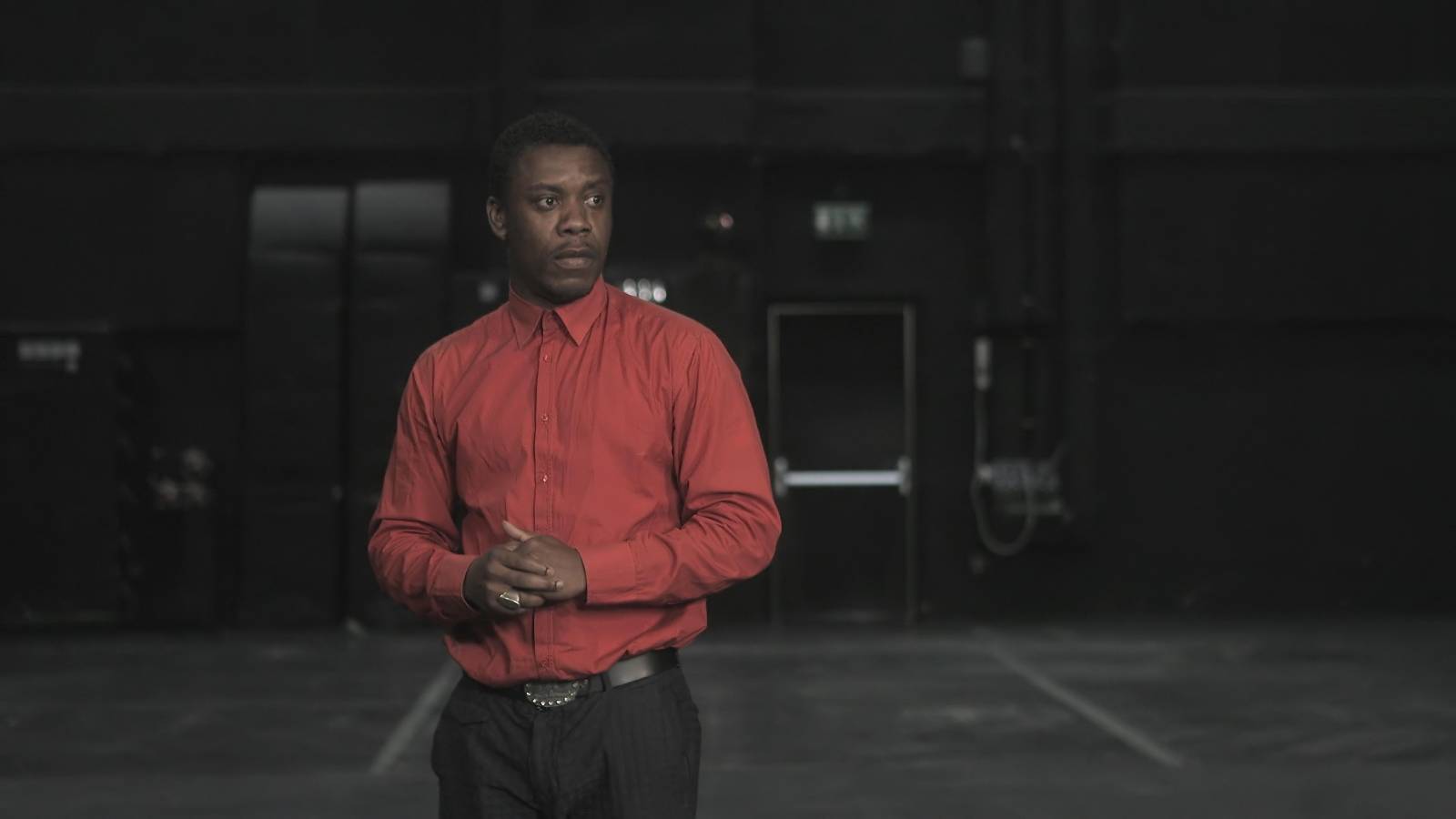
Report (2016) is the title of the paramount video installation presented last year at documenta 14 in Athens and Kassel. It is perhaps the cinematographically most complex among Friedl’s video installations, emphasizing the crisis and conventions of representation, and open to a variety of both formal and conceptual readings. In it, Friedl explores the permeability of language and identity boundaries. Seemingly compliant with classical dramatic theory, the only location of the
film is the large, empty stage of the National Theater in Athens. The source text is “A Report to an Academy” (1917) by Franz Kafka, a famous, often overinterpreted parable about assimilation, written in the Prague writer’s minoritarian German in the form of a monologue.
More than twenty actors, mostly non-professionals, appear on the stage, alone or in pairs.
They all recite by heart extracts from Kafka’s text in their own native tongue or a language of their choice: Arabic, Dari, English, French, Greek, Kurdish, Russian, and Swahili. Uniting them all, besides Kafka’s account of the humanization of the monkey Red Peter coming “from the Gold Coast,” is the actors’ physicality, the intentionality of their gestures, and the fact that they belong to today’s migrant populations, or rather, to the global community of men, women, and children in transit. Relying on their presence and charisma, the camera creates a multi-layered narrative thread directed by empathy and circumspection.
With some omissions and variations, Report remains faithful to the original narrative throughout the fragmented polyphony of languages and gestures, deliberately rejecting the diktat of subtitles. In his film, Friedl pushes the very idea of representation to its limit. Bodies, voices, languages, geographies, social classes, personal and political stories coexist in a complex and highly suggestive tableau vivant.
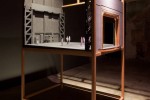
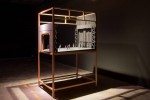
The second piece in the exhibition, Teatro (Report), is a large architectural model of the stage of the National Theater in Athens where Report was filmed in the summer of 2016. While the concept of model has been central to Friedl’s work for many years, once again the artist’s interest does not aim at mimesis or documentary evidence. Instead, Teatro (Report) functions as a memory theater referring to the Renaissance hermeticism of Giulio Camillo and Robert Fludd. The model is peopled with miniature figurines of the actors who performed in Report, including those who do not appear in the final version of the film. Teatro (Report) is an ambiguous, enchanted work: a performative sculpture in constant dialogue with its own compositional elements.
Peter Friedl (b. 1960) is an artist based in Berlin. His work has been exhibited internationally, including at Museo Nacional Centro de Arte Reina Sofia, Madrid; Centre Pompidou, Paris; Walker Art Center, Minneapolis; Van Abbemuseum, Eindhoven; and Hamburger Kunsthalle.
He has participated in documenta 10, 12, and 14 (1997, 2007, 2017); the 48th and 56th Venice Biennale (1999, 2015); the 3rd Berlin Biennial for Contemporary Art (2004); Manifesta 7, Trento (2008); the 7th Gwangju Biennale (2008); the 28th Bienal de São Paulo (2008); La Triennale, Paris (2012); the Taipei Biennial (2012, 2016); the 10th Shanghai Biennale (2014); and the 1st
Anren Biennale (2017). Selected solo exhibitions include OUT OF THE SHADOWS, Witte de With, Center for Contemporary Art, Rotterdam (2004); Work 1964–2006, Museu d’Art Contemporani de Barcelona; Miami Art Central; Musée d’Art Contemporain; Marseille (2006–07); Blow Job, Extra City Kunsthal, Antwerp (2008); Working, Kunsthalle Basel (2008); Peter Friedl, Sala Rekalde, Bilbao (2010); The Dramatist, Artspace, Auckland, (2014); The Diaries, Grazer Kunstverein, Graz (2016), and Teatro Popular, Lumiar Cité, Lisbon (2017).
This is the third solo-show at Guido Costa Projects.